Music, when the lyrics describe some purposeful emotion or thought. These posts are in a mix of English/Hindi or English/Kannada pairs. With the advent of Google's transliteration, it is unnecessary to have inconsistent and misleading hand-crafted English transliterations of originals, for Hindi and Kannada in this blog's case. [If a transliteration is required, it can always be produced by software]. Hindustani ragas are shown in Devanagari, e.g., ♫देश; Carnatic, in Kannada, e.g., ♫ಖರಹರಪ್ರಿಯ.
This is another composition by ಪುರಂದರದಾಸ that starts off with cynicism [about God], but ends up accepting God with surrender. (The other cynical composition is ಸತ್ಯವಂತರಿಗೆ ಇದು ಕಾಲವಲ್ಲ).
A fervent appeal, as most such appeals are, to God. भर दो झोली is used as a metaphor for achieving unity with God, although in the form of a more mundane gratification.
The mesmerizing sound of Lord Krishna's flute is described through the act of a housewife running towards the source of sound, abandoning the all-important house work ... That the raga ♫भैरवी, or ♫ಸಿಂಧು ಭೈರವಿ, has been chosen to bring out the lyrical essence visualized by the poet, ಪು ತಿ ನ, is noteworthy.
Acknowledgments are due to my dear friend, Alamelu Iyengar, the poet's daughter, for helping me present the correct lyrics. (Disclaimer: If mistakes still exist, you can attribute them to me, the blog post author).
A moving rendering of the Guru Nanak composition by Pt. Jasraj. The Guru exhorts:
"Meditate on the Lord, Oh my mind,
Otherwise, your life will be over without the Lord's name."
The first video (1988) is a concert to present, along with Smt. M S Subbulakshmi, Mahatma Gandhi's favorites. This particular number starts at 10:15 in the video.
This post is as reminiscent as it can get: I first heard the song when I was a high school student in Bangalore. It was very memorably rendered by one of my classmates during an 'Arts' class.
Recently, my music teacher suggested that this may be a good song for my collection.
I have excerpted a few lines from another blog post, ರಾಮ ರಾಮ ರಾಮ ಸೀತಾರಾಮ; this subset is the same as that chosen by the artist in the video rendering, given below.
The lyrics on the web are somewhat conflicting and I have, therefore, not provided any links to transliterations and have provided my own transliteration from listening to Bhimsen Joshi's rendering.
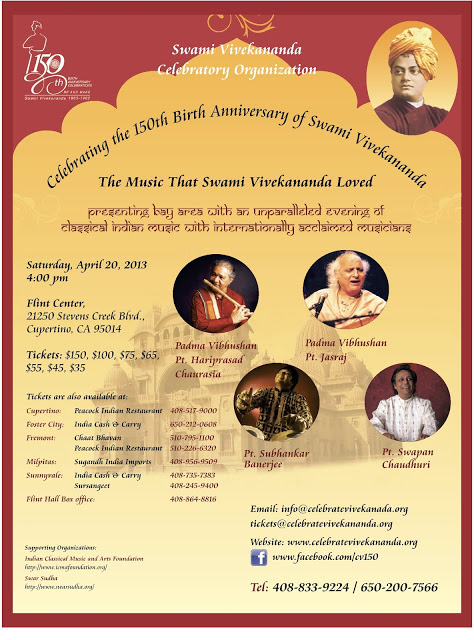
It is an ecstatic treat to listen to Pt. Jasraj render the निर्वाण षटकम्, written by Adi Shankaracharya. I had occasion to attend The Music that Swami Vivekananda Loved today, on the occasion of the 150th birth anniversary of Swami Vivekananda, where Pt. Jasraj introduced this song as one that Sri Ramakrishna Paramahamsa used to sing, and the one that Swami Vivekananda liked.
This song is a very popular song in Karnataka, and other parts of India. It captures the cry of a God-seeking person. God is personified as Lord Krishna in this composition.
You will find slight variations in lyrics on the web, but I have provided here my interpretations of Yesudas' rendering.
No collection of songs would be complete if the most favorite bhajan of Mahatma Gandhi were not included. October 2 is Mahatma Gandhi's birthday. The song goes on to define what a Vaishnav, i.e., a liberated one, is by elaborating on various characteristics of such an individual.
Since the original lyrics were composed in Gujarati, I won't give the lyrics here, but refer you instead to other web pages through the buttons below.
The poet writes a very simple set of lyrics to promote universal brotherhood, to suggest actions particularly when we meet the poor, unhappy, under-privileged, etc.
I first heard this song in Kargal, as shown in the map below.
If you know Kannada, you will appreciate the simplicity of the meaning conveyed in the lyrics. Rough English translation:
Rich people create temple
But, I am a poor fellow
I have nothing to give you, God, except myself:
My feet are the pillars
My body is the temple
My head is the "top ornament"
Even stationary objects providing support — a column — may perish some day
But, for Jangama, for God, there is no perishing, i.e., God is eternal.
It will require a singer like Vijay Prakash to bring out the plea with full force.
(The number starts at about 1:50 in the video clip).
A lovely metaphor in the form of a flower somewhere in the woods that feels isolated and not appreciated, because it feels that it has not gotten a chance to decorate someone's hairdo. The song appears also to refer to an individual that feels detached from the world, and longs not only to reach God but, at least, to be valued in the world. It is very ably sung by Vijay Prakash of 'Jai Ho' fame.
As you listen to it, you can also feel the pain that the flower might feel ... Glory to the poet who captured the emotion in words, and to the singer who brings the emotion alive.
On Mother's Day 2010, it is somewhat appropriate that we take a look at this song I encountered recently. While although मात्र देवो भव is a well known concept ingrained in Indian culture at an early age of a child, this song is a very good and melodious elaboration of that concept.